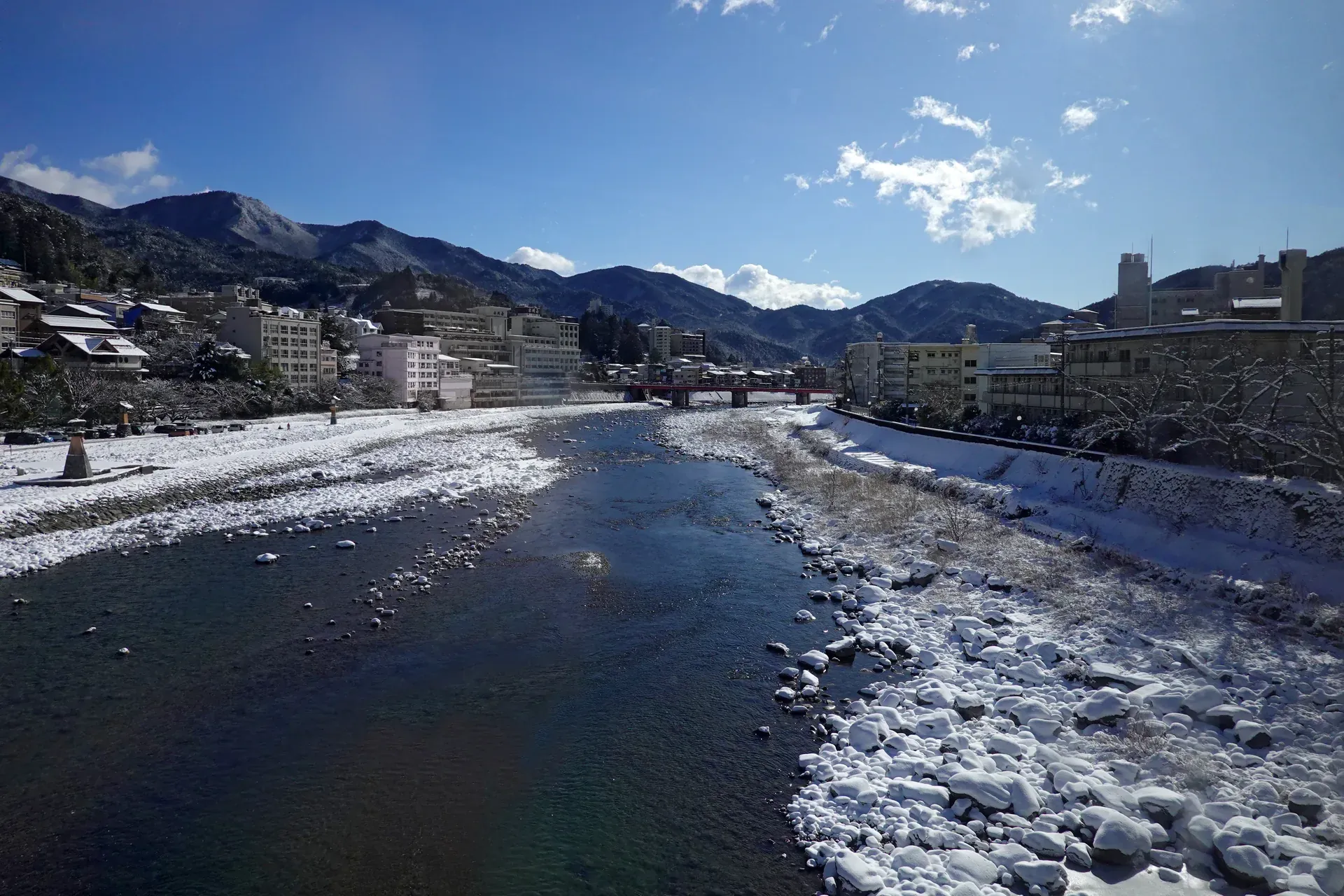
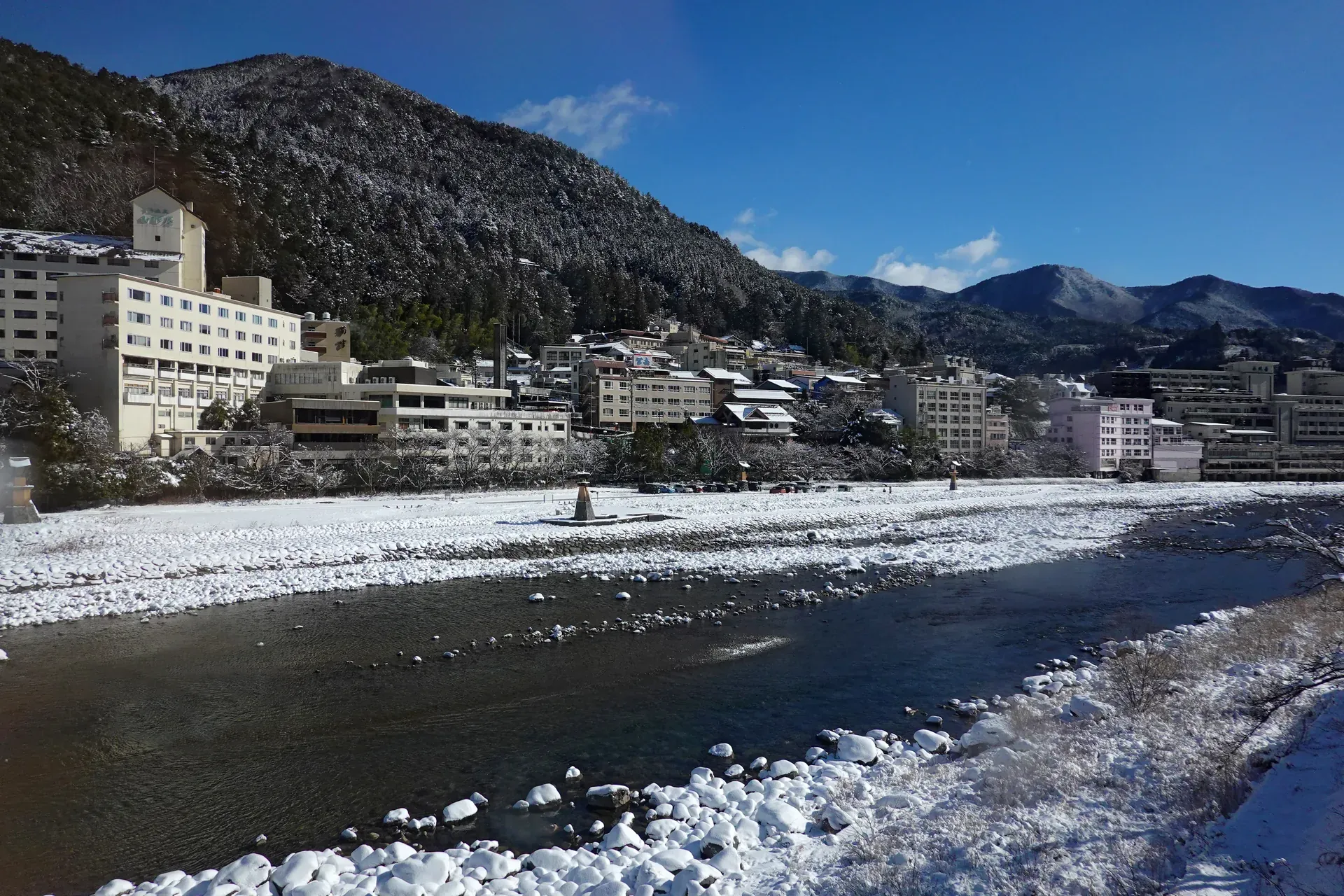
Gero Onsen along the Hida River
River, bridges and the hot-spring town in January 2026. These winter reference photographs are not a snow forecast or images of bathing interiors.
Planning checked: 2026-10-31
Check before setting off
Riverside Funsenchi has prohibited full-body bathing since 1 December 2021 and is described as footbath-only. Do not follow older descriptions of it as an open-air bath.
These snowy views were photographed on 25 January 2026. The Hida River connects buildings on both banks with the surrounding mountains. They explain the town’s setting, not the likelihood of snow during your visit.
Three things to look for
1 | Read the town along the river
In GK04, the river leads toward a bridge, buildings on both banks and the mountain backdrop. Before identifying individual inns, use it to understand the relationship between water and town.
2 | Notice the snow and river stones
GK03 brings one bank and its buildings closer, with snowy stones tracing the water’s edge. Winter conditions vary by day and year; this photograph does not promise the same snow or colours.
3 | Add a stop to understand onsen
Gero Onsen Museum approaches hot springs through science and culture, including activities examining salinity and pH. It adds a non-bathing way to connect the riverside scene with the town’s hot-spring identity.
Read the photograph & local culture
Compare the river’s width, building density and nearby mountains across the two images. Hotel exteriors do not establish access to their baths or rooms. Nor do the photographs verify a safe route down to the river in snowy conditions.
Gero preserves a legend of a white egret revealing a new spring, a motif repeated around town. Its reputation among Japan’s celebrated hot springs is linked to writings by Banri Shūku and Hayashi Razan. Keep legend, historical reputation and present-day facilities distinct as you explore.
From a major station
JR Gero Station, Takayama Line
Reach Gero Station on the JR Takayama Line from the Nagoya/Gifu direction. Check the train type, changes and departures for your date.
For a riverside destination, the tourism association lists Funsenchi about 3 minutes on foot from Gero Station. Follow current access signs; do not go there for full-body bathing.
Official tourism guidance checked; external link withheld [g_funsen]Alternatively, the city gives about 8 minutes on foot from the station to the onsen museum. This is a separate station-to-museum leg, not an extra 8 minutes from the river.
A numbered station exit and routes to the exact photo viewpoints are unverified. Do not force a riverside descent during snow, ice or high water; follow pavement and bridge restrictions.
These are route segments, not a guaranteed total journey time. Travel-date departures, fares and current admission prices are not verified.
Nearby culture, food & rest stops
Optional stops, not guaranteed openings or a combined ticket.
Sagi no Ashiyu
A roofed cypress footbath listed by the city, opposite the onsen museum: a possible pause during a town walk.
The city page’s content date is 2019. Cleaning, maintenance and same-day availability require checking; continuous operation is not guaranteed. Bring a towel.
Yuamiya
Beside Gero Onsen Shrine, Yuamiya lists soft serve with an onsen egg, warmed pudding and souvenirs on its official site. It is an optional stop rather than a guaranteed available seat or menu item.
The shop states that days and hours can change. Current operating times were not verified and are not reproduced here.
Gero Onsen Museum
The museum also has a footbath for ticket holders, separate from free street-side footbaths. Its visitor guide requires a towel.
Listed hours are 09:00–17:00, last entry 16:30; closed Thursdays or the next day after a holiday Thursday, plus 30–31 December. Verify changes and admission before visiting.
Before you go / what remains uncertain
If adding a bath, check the chosen facility’s reception hours and day-use rules. Footbaths, public baths and guest-only hotel baths do not share the same access conditions. The photographs are landscape references, not promises of health benefits.
Photographer permissions, exact viewpoints, current weather, temporary access and same-day availability are not independently established by these photographs.
Checked sources
Checked 2026-10-31. Official pages may change; these notes are not a firsthand visit report.
- Official tourism guidance checked; external link withheld [g_funsen]
- Gifu Tourism Federation — Funsenchi
- JNTO — Gero Onsen
- Gero Onsen Museum — official
- Gero Onsen Museum — visitor guide
- Gero City — Onsen Museum
- Gero City — Footbath guide
- Gero City — Onsen Shrine
- Official tourism guidance checked; external link withheld [g_history]
- Yuamiya — official store information
- Yuamiya — official homepage
Original photograph & route notes
Arrive at Gero Station on the JR Takayama Line. Use “Maps / parking” on Gero City’s official tourism site to plan a riverside walk.
Route details
- Station
- JR Gero Station (Takayama Line); rail access from Nagoya or Gifu.
- Exit
- No numbered station exit is specified in the cited official guidance.
- On foot
- No unverified station-to-photo-viewpoint walking time is given.
- Before setting off
- Check the specific inn or bath for day-use availability; the town photographs do not imply admission to private hotel baths.
Access checked: 2026-10-31
What to look for
River and town together
The bridge and buildings along both banks give a wider sense of the destination.
Gero City official tourism site ↗A second winter perspective
A complementary riverside view, captured on the same January 2026 visit.
Gero City official tourism site ↗Make a day of it
Sightseeing and bathing are separate
Start with the river landscape; confirm current opening and day-use conditions before adding a bath.
Gero City official tourism site ↗Official sources & checks
Checked: 2026-10-31